
Disclosure: This post contains affiliate links. If you purchase through our links, we may earn a small commission at no extra cost to you.
Many buyers compare power banks by capacity alone.
10,000mAh.
20,000mAh.
But another number matters just as much:
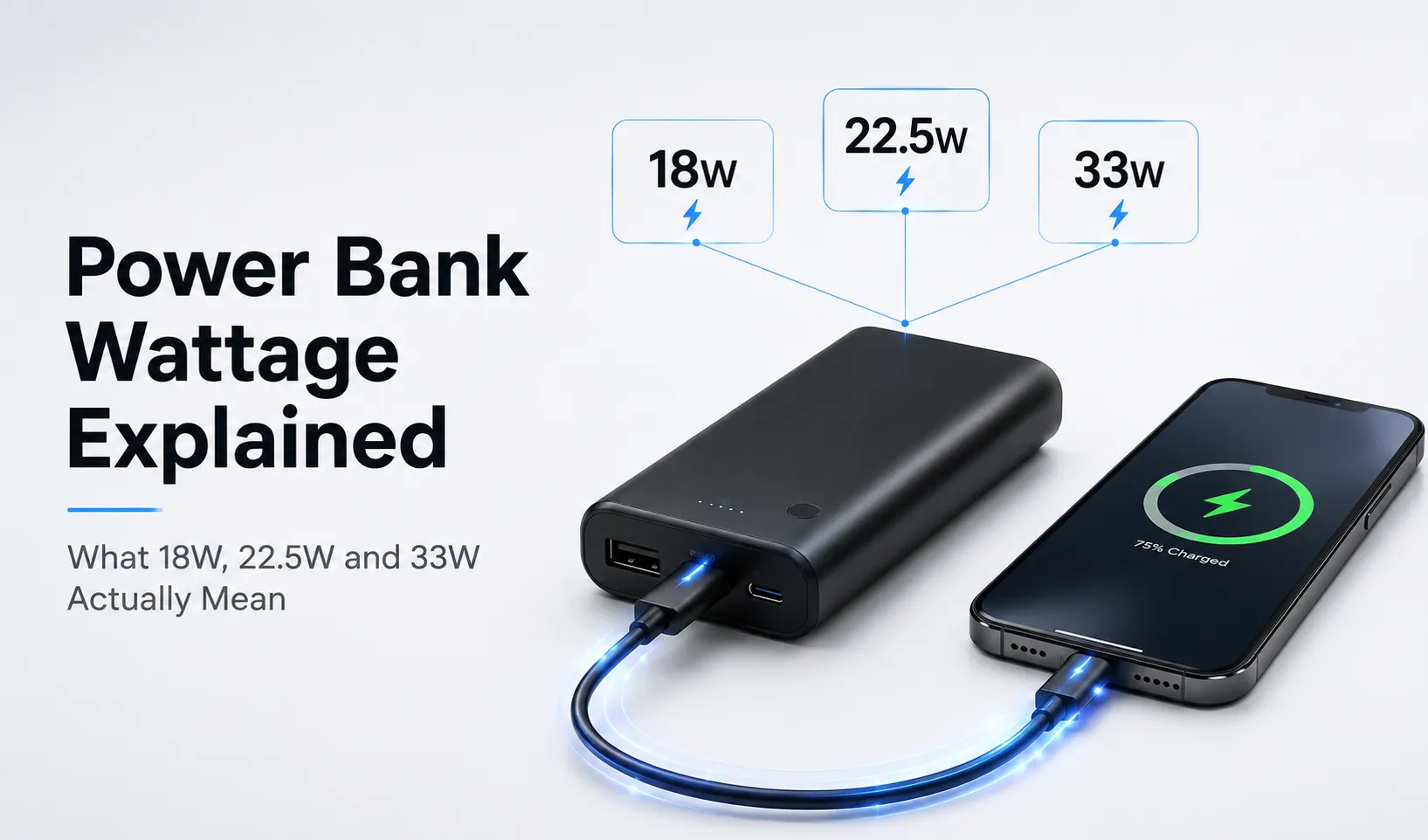
18W. 22.5W. 33W.
This number tells you how quickly a power bank can deliver power, making it one of the most important specifications to understand before buying.
What Does Wattage Mean?
W (watts) measures power—the rate at which energy is delivered.
Unlike mAh, which describes stored battery capacity, wattage describes charging speed.
Think of it like this:
- mAh = How much backup you have.
- W = How fast compatible devices can receive power.
Why 20,000mAh Doesn’t Automatically Charge Faster?
This is one of the biggest buying myths.
Imagine two power banks:
Power Bank | Capacity | Maximum Output |
Power Bank A | 10,000mAh | 33W |
Power Bank B | 20,000mAh | 18W |
Power Bank B stores more energy.
But Power Bank A can potentially charge a compatible phone faster because it can deliver power at a higher rate.
What Do Common Wattage Ratings Mean?
18W
Still a solid everyday fast-charging option for many smartphones.
Best for:
- Budget phones
- Everyday charging
- Backup power
22.5W
A noticeable step up for many compatible devices.
You’ll commonly see this on modern mid-range power banks and phones that support higher charging speeds.
33W
A better choice for compatible devices that can take advantage of higher power delivery.
It offers more headroom for:
- Newer smartphones
- Larger batteries
- Faster top-ups during busy days
Does Your Phone Always Charge at the Power Bank’s Maximum Wattage?
No.
Charging speed depends on both devices agreeing on a supported charging mode.
For maximum speed, three things should match:
- Your phone’s supported charging standard
- Your power bank’s supported output
- A suitable charging cable
The system automatically negotiates an appropriate charging level.
USB Power Delivery (USB PD) Matters Too
A high wattage alone isn’t enough.
Many modern phones use USB Power Delivery (PD), which allows compatible devices to negotiate safe charging levels over USB-C.
When choosing a power bank, look for:
- USB-C output
- USB Power Delivery support
- Compatible charging cables
Which Wattage Should You Choose?
Your Need | Recommended |
Everyday backup | 18W |
Faster everday charging | 22.5W |
Maximum speed for compatible phones | 33W |
Remember:
Buying a higher wattage doesn’t guarantee faster charging if your phone doesn’t support it.
Common Mistakes to Avoid
- Choosing only by mAh.
- Assuming higher wattage always means your phone will charge faster.
- Ignoring USB-C PD support.
- Using low-quality charging cables with fast-charging power banks.
Final Word
The best power bank isn’t simply the one with the biggest battery—it’s the one that matches your phone’s charging capabilities.
Think of it this way:
- mAh tells you how much backup you get.
- W tells you how quickly compatible devices can charge.
- USB PD helps compatible devices negotiate efficient charging.
Understanding these three specifications makes it much easier to choose a power bank based on real-world use instead of marketing numbers.